Wednesday, 24 April 2013

Evaluation Question 3

What kind of media institution might distribute my media product and why?

What kind of film are we making.
  • An independant british superhero dark comedy with elements of teen comedy-drama, action and tragicomedy.
  • Aimed at teens (specifically men).
What do distributers do?
Distributers are responsible for the marketing of the film. They set the release date and the meathod of release for the product. These include:
  • Theatrical release (in cinemas)
  • Direct to DVD
  • Video on Demand (through things like Love film and Netflix. The show is streamed directly to your computer or TV through the power of the internet. Also using Iplayer and various other internet catch up sites)
  • DVD on Demand (usually used to distribute cheap, homemade horror movies. Order from a website and the company will burn the film onto a disc and send it to you. Good way of getting cheap, terrible horror films).
  • Download
  • Television seies, miniseries or TV film.
  • Film Festivals (Sundance, Cannes)
Distribution companies are also responsible for the overall hype and media attention of the film. They produce posters, trailers, TV spots, internet pages, Facebook and twitter accounts and even Youtube pages. They are also in charge of censorship of the film and dubbing/subtitling foregn films they import to the UK/ US.
Distribution is the most important part of the filmmaking process as without it the film would never be seen.

What would I expect them to do?
I would want my distributers to set up a facebook fan page, design posters for magazines, cinemas and internet webpages. I would also get them to edit trailers and TV spots and put them in theatres, TV stations and social media/video sharing sites like facebook, vimeo & Youtube. Also I would like them to show my film at an independant film festival.

What media institutions could we get and why?

Vertigo films are known for producing and
distributing independant British films.


Lionsgate have produced the films Kick-Ass and the action film
The Expendables. They are an independant company


This company have produced alot of comic book films
like 300, Watchmen, Superman Returns & the Dark Knight Trilogy.
They are also involved in the production/distribution of the upcoming Man Of Steel.


Responsible for the international distribution of the dark comedy superhero film Super.

Evaluation Question 2

How does my media product represent particular social groups.

  • Stereotypical teenage males (anger, agression, lonlieness)
  • Outsiders (Used alot in superhero films and also teen dramas and even rom-coms).
  • Both stereotypical and archetypal nerd (goes from a weak nerd to a tough super villain, reminds me of Sydrome from The Incredibles).
  • Normal kids (neither character actually have any powers, like in Kick Ass).
In my film clip I wanted to portray the stereotypical idea of teenaged males in Britain.

The hero is a normal British kid who falls out with his girlfriend and will do anything to get her back, including becoming a superhero (well it's the thought that counts.) All alone in the world he takes out his agression in the typical male way and beats up the nerdy kid. He sinks into a moody, depressed state because he is all alone in the world now. Then he becomes a superhero hoping his ex will get in trouble so he can save her (Perhaps the word normal was the wrong one to use.)

Or villain is a nerdy outcast, who reads comic books, watches Superhero films, and spends his life alone. His years of lonliness have caused his mind to wander into strange delusions and dangerous daydreams. After he is attacked he cracks, bulks up and becomes a violent bad guy. He is not so stereotypical because of his fall into madness, but the themes of lonliness and teenage angst and alienation are portrayed through him

Tuesday, 23 April 2013

Evaluation Question 1


In what ways does our media product use, develop or challenge forms and conventions of real media products?
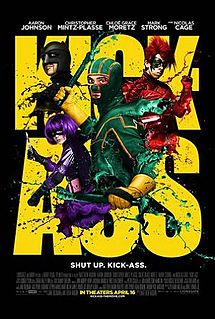
The idea of a superhero film mixed with dark comedy and
relationships was inspired by the film kick-ass, which
also inspired the voice over.
We wanted our film to seem like an independent superhero action comedy. Because of this, our logos are made to look comic book style and used parodies of superhero movie and companies. To immediately introduce our audience to the comedic undertones in our film. From a black screen we cut directly to a shot where the hero is thrown against the wall in a mid-shot. This is to attract our audience and get them straight into the action. It also breaks the traditional linear narrative structure by showing the last battle before the opening titles. We give the impression that if we continued the film; we would tell the audience how we got to the final battle before showing it again along with its aftermath.  The next shot is a mid-2-closeup shot in which we are introduced to our villain, who grabs the hero. This is explaining the first shot and introducing the stereotypical superhero conventions of having the hero vs the villain. We then flow the motion of the villain tossing the hero to the ground using the mid-2-closeup, then an aerial shot and finally a low angle shot as the hero hits the ground. This shows traditional fight scene conventions, which often feature short, quick cuts and show a single sequence in three of four shots. We then go into an over the shoulder shot to make the audience feel as though they are there watching this battle as it happens and witnessing the brutal fight. Then we see the mid-2-shot as our hero punches the villain into the wall. The action flows as the camera follows the villain into the wall so the audience see all of what is happening in the scene. As the villain lies on the floor, he is seen in a high-angle shot, which is a conventional way of showing characters in a venerable position. The hero than picks the villain up, spins him round and throws him into the wall in a mid-2-shot. This is to show our protagonist and antagonist locked in battle and is symbolic in most superhero films. In the next shot, we see the villain in a wide shot on the floor as the hero sees if he is conscious, before the bad guys kicks the good guy to the floor, revealing that he was playing possum. The camera then follows the hero as he gets to his feet and is punched to the floor by the villain. We wanted to use a convention from superhero fight scenes, in which the villain almost wins before the hero surprises everyone and comes out triumphant. Because of this the villain mainly dominates the fight scene. We continue this theme with a very low angle shot (from the hero’s POV) of the villain as the music becomes more menacing. A quick shot-reverse-shot shows the hero, then back to the villain who goes for a punch. Just before he connects, the screen cuts to black, the music stops and the hero narrates an introduction. The idea of using the voice over comes from films like Spiderman, and Kick-Ass. Voice-Over is also useful because of the nonlinear narrative structure, as the hero explains that he used to be a normal kid and the story is about to tell you what changed. After this the titles themselves run. Unlike superhero films, our title’s play out more like a teen drama film, showing black and white still photographs with brightly coloured writing in front of them. Breaking the conventions of the superhero movie shows our audience that this is not a stereotypical superhero movie, and our photograph idea coming, weirdly, from the film Mean Girls. The black and white photos tell a story, much like the French surreal sci-fi film La Jetée. Our photo story tells us how the hero lost his only friend and takes it out on the nerdy kid (breaks conventions because the nerdy kid becomes the villain, not the hero). We used this form and story to convey the themes of loneliness (in both the hero and villain), and we did not want this to be a straight forward, typical superhero film and create a hybrid between the superhero film and teen dramas, brutal action, dark comedy and tragicomedy.

Our idea of using non-linear narrative and the
themes of lonlieness and isolation
were influenced by Zack Snyder's film Watchmen.


Sunday, 14 April 2013

MEDIA STUDIES FILM OPENING: FIRST DRAFT


The first attempt at our finished piece. I still need to make some scenes shorter, cut out the last scene & rerecord/add James' Voice over narration. For a first attempt however, I think it went quite well. the music goes well the scene and the sound effects are in time. It's not the best quality and is very long, but I can fix that.

Saturday, 13 April 2013

mood board

We have created this mood board to give us some idea of the kind of costumes of the heros and villains of the comic-book world. We chose a wide range of pictures, including posters, pictures of character and comic covers. We have some Marvel, some DC and some alternative comic characters in order to give us a good range of heros to draw our inspiration from.

Wednesday, 3 April 2013

video diary 2


In this video diary, we come to you from our location on our day of shooting. We discuss our upcoming fight scene and how we prepared for it and also take a look at the costmes we wore in the fight scene.